
Which Vector VR2 table size fits your sheets
A practical guide to choosing between the Vector VR2 1313, 1325, 1530, 2030 and 2040 table sizes using your stock sheets, parts, workflow and workshop.
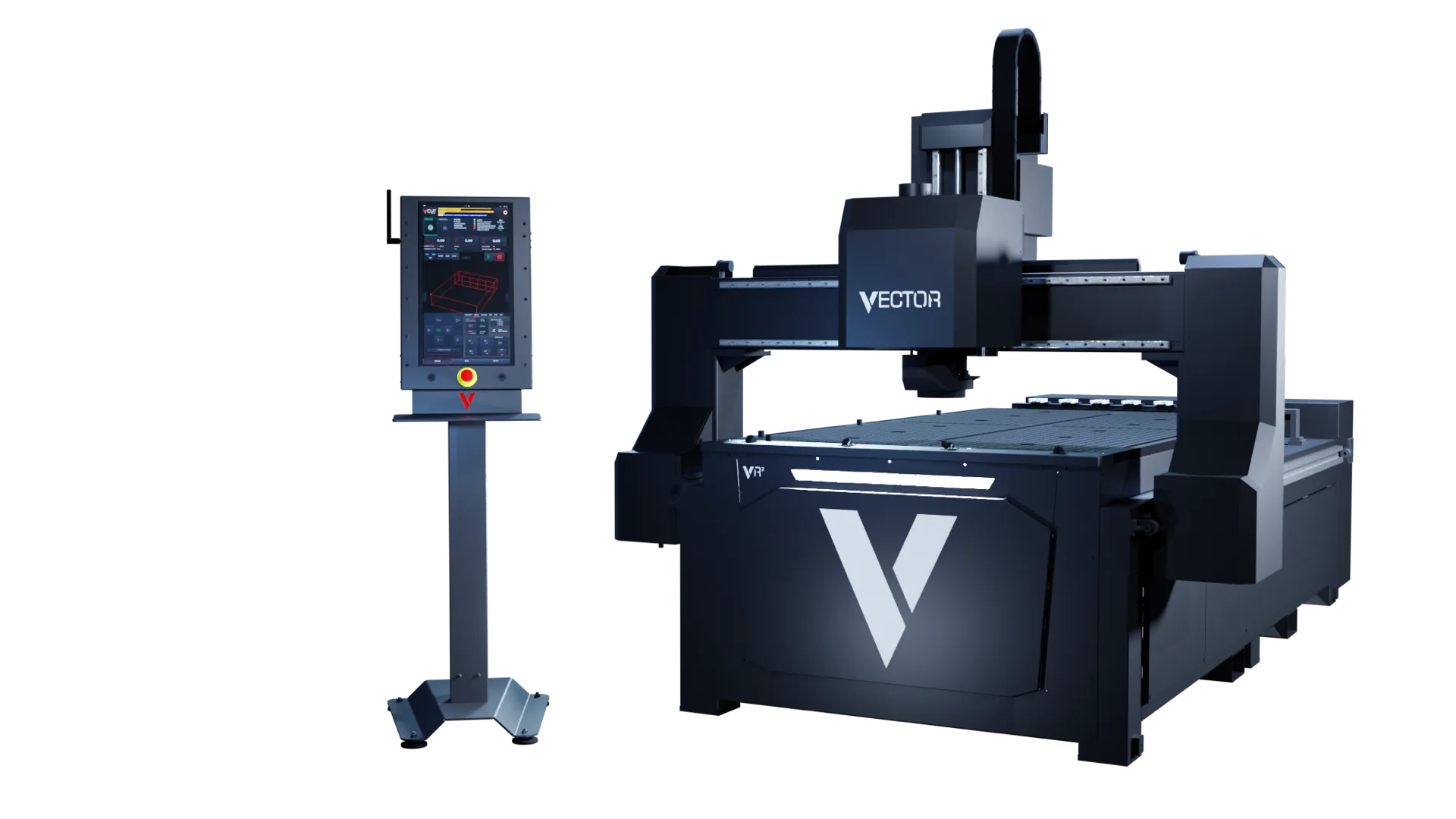
Choose a table around the material you process repeatedly, not the largest sheet you might cut one day. The right Vector VR2 should accommodate your normal stock and useful part layouts without taking up workshop space that your production does not need.
Table size is the starting point. The final working area, vacuum arrangement, machine access and site requirements are confirmed for the configuration you order.
Five standard table sizes
The model code identifies the nominal table size. For example, 1325 means a 1300 × 2500 mm table.
| Platform | Table size | A useful starting point when |
|---|---|---|
| 1313 | 1300 × 1300 mm | You mainly process smaller sheets, cut-down stock or compact components |
| 1325 | 1300 × 2500 mm | Your normal stock is a standard 8 × 4 ft sheet |
| 1530 | 1500 × 3000 mm | Your sheets or part layouts need more width or length than the 1325 provides |
| 2030 | 2000 × 3000 mm | Width is the main constraint for larger panels or layouts |
| 2040 | 2000 × 4000 mm | You regularly process longer sheets or large-format layouts |
A standard 8 × 4 ft sheet is approximately 2440 × 1220 mm, so the 1325 is the first format to compare for that stock. Do not treat the difference between the sheet dimensions and table dimensions as guaranteed cutting clearance. Confirm the working area and material setup for the machine you specify.
Use your real sheet list
Write down the actual dimensions of the stock you buy. Names such as “8 × 4” are convenient, but the dimensions supplied for a material can vary. Include:
- each sheet size and material;
- how often you use each size;
- whether sheets arrive at full size or are cut down first;
- the largest finished part you need to produce.
Choose around the sheets that account for most of your work. An occasional oversized job may not justify a larger standard machine if it can be handled another way or with a custom specification.
Check the layout, not only the sheet
A sheet fitting on the table does not prove that the format suits the job. Review a few representative cutting files and check:
- the orientation of the largest part;
- whether parts can be arranged efficiently on the sheet;
- whether you run one-off parts or repeated batches;
- how you position smaller sheets and reusable offcuts;
- which vacuum zones and hold-down arrangement the job needs.
This comparison can reveal that a wider table is useful even when the raw sheet fits a smaller format. It can also show that a larger table would add little to your normal production.
Compare the closest formats
If you mainly buy 8 × 4 ft sheets, start with the 1325. Compare it with the 1530 only when your stock, part orientation or layouts make use of the additional width or length.
If your work needs close to 2000 mm of table width, compare the 2030 and 2040 against the length of your normal stock and layouts. The 2040 is useful when that extra length is regularly needed; it is not automatically the better choice for work that fits a 2030.
For smaller stock and components, compare the 1313 with the 1325. The question is whether full-sheet capacity would be used often enough to justify the additional space.
Allow for the complete installation
Table size is not the machine’s overall footprint. The workshop also needs suitable access for delivery, material loading, operation and trained service work, together with the required extraction, vacuum, electrical and compressed-air services.
Before quotation, DXF reviews the selected configuration and installation space. Do not plan the workshop from the table dimensions alone.
When the standard sizes do not fit
If none of the five formats suits the material, layouts or available space, ask about a custom table size. Access, services and the final specification are reviewed before quotation.
What to send for a useful recommendation
Send DXF:
- your normal materials, thicknesses and exact sheet sizes;
- the largest part dimensions;
- two or three representative cutting layouts, if available;
- typical batch quantities and expected production pattern;
- the available installation space and how material reaches the machine.
With that information, the team can compare the closest table sizes and then match the vacuum, spindle, extraction and tooling configuration to the work.